

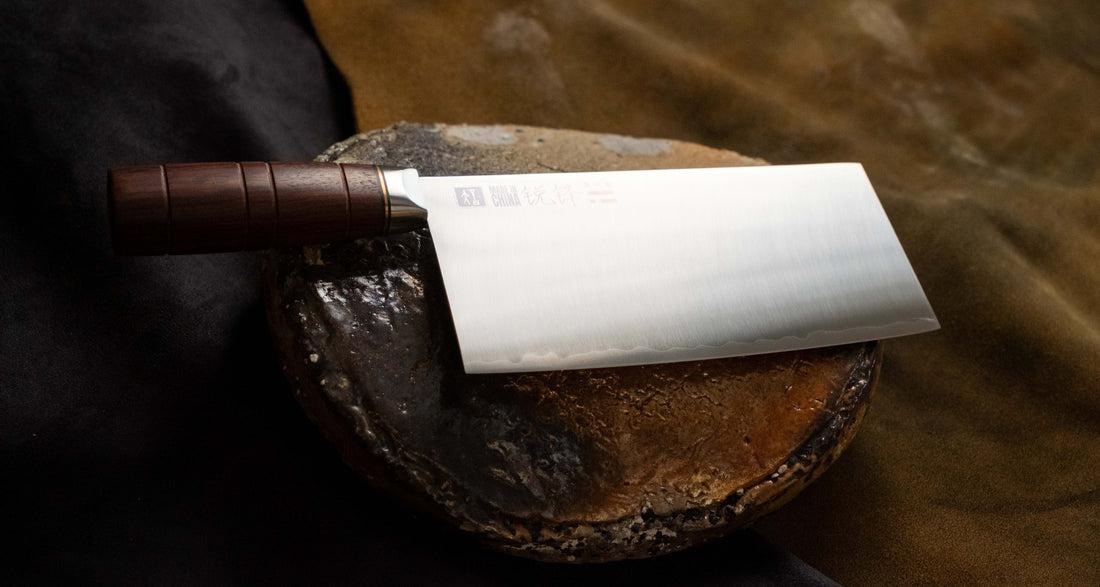
Yes—a Chinese cleaver can replace a chef knife for much of your everyday preparation, especially when your cooking involves vegetables and boneless meat. The important qualification is that we are talking about a slicing cleaver: a broad blade designed for controlled cuts. Its rectangular outline does not make it suitable for chopping bones.
The choice depends on how you cook, how you move the blade and which tasks you expect one knife to handle. A wide cutting face can simplify chopping and transferring ingredients, while a pointed blade offers advantages for detailed work.
At SharpEdge, our selection includes japanese knives, Chinese-style cleavers and gyuto knives, so we can approach this question through specific blade designs rather than treating every rectangular knife as the same tool.
What Kind of Chinese Cleaver Are We Comparing?
“Chinese cleaver” describes a shape, but it does not tell us everything about thickness, weight or intended use. Thin slicing versions handle vegetables, herbs and boneless proteins. Heavy cleavers built for bone work belong to a different category. We need to check the individual model before deciding what it can replace.
The Chinese-style kitchen blade is commonly called a cai dao. In Japan, the corresponding style is known as chuka bocho. Neither name guarantees a particular steel, grind or weight, and a Chinese-style knife can be manufactured in Japan or elsewhere.
Our XinZuo Cai Dao Chinese Cleaver 190 mm, for example, is made in China. It has a 9Cr18MoV steel core, SUS410 cladding and a listed hardness of 58–60 HRC. Our product description specifies vegetables and boneless proteins, with an explicit warning against bones and joints.
The Yaxell Zen Chinese Cleaver 180 mm is made in Japan and uses VG-10 steel, with a listed hardness of 61 HRC. It also belongs to the slicing category. These examples establish the starting point: we are comparing general food preparation tools, not choosing a blade for butchery.
Where the Broad Blade Helps
A tall blade gives us substantial knuckle clearance and a broad surface against which to guide ingredients with a properly formed claw grip. It can be useful when working through cabbage, slicing scallions, dicing onions or cutting carrots into strips. The relatively straight cutting profile encourages controlled chopping and push cuts.
The broad face also helps transfer chopped food. Instead of gathering several small loads, we can lift ingredients on the blade. When collecting them, we should keep the cutting edge from scraping sideways across the board; use the spine or a separate scraper.
Boneless proteins fit naturally into this workflow. A slicing cleaver can portion chicken breast, cut pork for a stir-fry or slice tofu, provided the food is thawed and the blade is suitable for the task. We still need a clean cutting motion rather than twisting or levering through resistance.
Its size does not guarantee effortless cutting. The grind and thickness behind the edge affect how readily the blade passes through food. A tall blade may provide useful control, but a heavier model can also require more effort to lift repeatedly. We should assess geometry and handling together.
Where a Pointed Blade Still Makes Sense
A chef knife remains convenient when preparation involves frequent tip work. Trimming small areas of fat, making precise incisions and working around awkward shapes can be easier with a narrower point. A rectangular blade can perform some detailed cuts, but it offers a different view of the contact area and requires a different approach.
The gyuto is the Japanese interpretation of this general-purpose shape. For readers comparing a japanese chef knife with a chuka bocho, the useful distinction is the cutting profile and pointed tip, alongside the specifications of each model.
Our Tojiro Gyuto Zen 210 mm illustrates that alternative. It has a VG-10 blade, a symmetrical double bevel and a magnolia wood handle. Its longer, narrower blade provides a different handling option from the two cleavers discussed here.
Rocking is another consideration. A curved cutting edge can suit cooks who keep the tip near the board while raising and lowering the heel. Chinese-style slicing blades generally encourage a more direct chopping or push-cutting motion, although their exact curvature varies. We should not assume that every gyuto rocks equally well or that every cleaver has a completely flat edge.
Compare Measurements Before Choosing
Product dimensions reveal differences that photographs can hide. The XinZuo model lists a blade height of 93 mm and a weight of 309 g. The Yaxell Zen lists 72 mm and 315 g. The Tojiro Gyuto Zen lists 44 mm and 135 g.
Those figures show why a shorter blade is not necessarily lighter. The two cleavers have different heights yet similar listed weights, while the longer gyuto is substantially lighter. This comparison applies to these models; it is not a rule for all knives in either category.
Weight can provide momentum, but that benefit is personal. Some cooks appreciate it during repetitive vegetable preparation; others prefer less mass when changing direction or working for longer periods. Handle shape and balance also affect how manageable the knife feels.
Our cleaver vs chef knife guide explains the broader differences in profile and technique. When choosing an individual knife, we would then check:
- Blade height: Does it provide useful clearance without feeling cumbersome during the small cuts you make regularly?
- Weight and balance: Can you lift, stop and redirect the blade comfortably, rather than relying on its mass to force a cut?
- Cutting profile: Does the edge suit push cuts, chopping or the rocking motion you already use?
- Handle and grip: Is the transition from handle to blade comfortable, with enough space for a secure pinch grip?
- Board and storage: Do you have room for the blade, the ingredients and safe storage that protects the cutting edge?
Can We Really Use One Knife for Everything?
A Chinese cleaver can become your main board knife, but “everything” needs sensible limits. The slicing models discussed here should not be used on bones, joints or frozen food. A thin, hard edge can chip when exposed to impact or sideways loading, regardless of the blade’s broad appearance.
Neither shape replaces every specialist tool. A serrated bread knife remains useful for crusty loaves, and a small paring or petty knife is easier to handle for peeling and other work away from the board. Large rectangular blades also need care around dense produce: if the edge becomes trapped, we should avoid twisting it free.
We therefore think of replacing the main preparation knife as a change in workflow, not a promise to empty the knife drawer. For vegetable-heavy meals, soups and stir-fries, a slicing cleaver can cover a large proportion of the work. For frequent precision trimming and tasks that benefit from a pointed tip, a gyuto may be the more comfortable first choice.
Choose the Shape You Will Use Well
Whichever profile we choose, the board and maintenance routine matter. Wood, suitable plastic and rubber cutting boards are preferable to glass, stone or ceramic surfaces. Wash the knife by hand, dry it after use and store it so the edge cannot strike other utensils.
At SharpEdge, we offer sharpening stones, protective sheaths and sharpening services alongside our knives, allowing care to be considered as part of the choice. Steel hardness alone does not tell us how long an edge will remain useful; geometry, cutting technique, board contact and sharpening all contribute.
If your chef knife spends most of its time chopping vegetables and portioning boneless ingredients, a Chinese slicing cleaver is a credible replacement. If you rely on a fine point and prefer a lighter blade, the Tojiro-style gyuto approach may suit you better. Picture preparing your usual dinner: the better choice is the blade whose shape helps you make those cuts comfortably and consistently.
